Bachelor of Science in Nursing – RN to BSN program guide
The complete current public path: program, exact course code, then the registered Module or verified Empowered Learning project layer.
Every exact course code printed for this program in the 2025–2026 catalog is linked to a full class guide. Public substitutions and scheduled addendum changes remain labeled instead of being flattened into one required sequence.
The July 7, 2026 catalog addendum publishes a new RN-to-BSN curriculum effective October 5, 2026. The table keeps courses from the current curriculum and courses first published for Fall 2026 visibly labeled; it does not merge them into one student's plan.
Read the public program map correctly
This program prepares the graduate as a nurse adhering to the American Nurses Association (ANA) Scope and Standards of Practice and Code of Ethics. Students develop a professional identity as advocates, leaders, and innovators grounded in a sense of inquiry and commitment to lifelong learning. Knowledge provided by a liberal education, integrated with nursing principles, serves as a foundation for the development of clinical reasoning, scaffolding into the application of clinical judgment and evidence-based practice. Graduates are prepared to collaborate with interprofessional teams and promote excellence through cost-effective, accessible, multidimensional care in a rapidly changing, multicultural, global environment. Emphasis is placed on the promotion, maintenance, and restoration of health as graduates prepare to practice among communities of interest. The innovative, outcomes-based, laddered curricular framework aligns with the Quality and Safety Education for Nursing (QSEN) Competencies, National League for Nursing (NLN) Education Competencies, and American Association of Colleges of Nursing’s (AACN) The Essentials: Core Competencies for Professional Nursing Education. The program is differentiated by relevant, contemporary curricular design and innovative courses, including the choice of nursing electives.
The source is the current 2025–2026 Rasmussen Catalog and Student Handbook together with its July 7, 2026 addendum. This page records the catalog identity and public course choices; it does not claim that every listed code belongs in one student's schedule. Location, licensure status, entrance option, specialization, transfer evaluation, prerequisites, substitutions, and advisor approval can change the registered plan.
The official directory and catalog page were checked July 30, 2026. Recheck both before registration because program availability, campus closures, state rules, clinical placement limits, and future-effective curriculum changes can move independently.
The classes, one by one
| Course | Current catalog title | Credits | Public role |
|---|---|---|---|
| STA3215 | Inferential Statistics and Analytics | 4 | current and Fall 2026 curricula |
| NUR3306 | Integration of Genetics and Genomics into Ethical Nursing Practice | 4 | current catalog |
| NUR3472 | Emerging Healthcare Technologies and Innovation | 4 | current catalog |
| NUR3561 | Practice Excellence Through Innovation | 2 | current catalog |
| NUR3643 | Research and Theory | 5 | current catalog |
| NUR4153 | Clinical Reasoning and Clinical Judgment | 5 | current catalog |
| NUR4244 | Public Health Nursing | 5 | current catalog |
| NUR4327 | Influence of Policy, Finance, and Law on Healthcare | 4 | current catalog |
| NUR4590 | Professional Identity of the Nurse Leader | 5 | current catalog |
| NUR4681 | Global Health | 4 | current catalog |
| NUR4922 | Bachelor of Science in Nursing Capstone | 4 | current catalog |
| NUR3738 | Integrative Nursing | 4 | current catalog |
| NUR3894 | Contemporary Issues in Nursing | 4 | current catalog |
| NUR3907 | Scholarly Communication in Nursing | 4 | current catalog |
| NGR5013 | Foundations of Advanced Nursing Practice | 4 | current catalog |
| NGR5800 | Leading Healthcare Transformation | 4 | current catalog |
| NUR3055 | Professional Nursing Role Transition (effective Fall quarter 2026) | 5 | Fall 2026 curriculum |
| NUR3455 | Professional Communication in Nursing (effective Fall quarter 2026) | 5 | Fall 2026 curriculum |
| NUR3475 | Healthcare Technology and Informatics in Nursing (effective Fall quarter 2026) | 5 | Fall 2026 curriculum |
| NUR3565 | Nursing Policy, Ethics, and Law (effective Fall quarter 2026) | 5 | Fall 2026 curriculum |
| NUR3645 | Evidence-Based Practice in Nursing (effective Fall quarter 2026) | 5 | Fall 2026 curriculum |
| NUR3835 | Quality Improvement in Nursing (effective Fall quarter 2026) | 5 | Fall 2026 curriculum |
| NUR4245 | Population and Public Health Nursing (effective Fall quarter 2026) | 5 | Fall 2026 curriculum |
| NUR4595 | Nursing Leadership and Management (effective Fall quarter 2026) | 5 | Fall 2026 curriculum |
| NUR4926 | RN-BSN Capstone (effective Fall quarter 2026) | 6 | Fall 2026 curriculum |
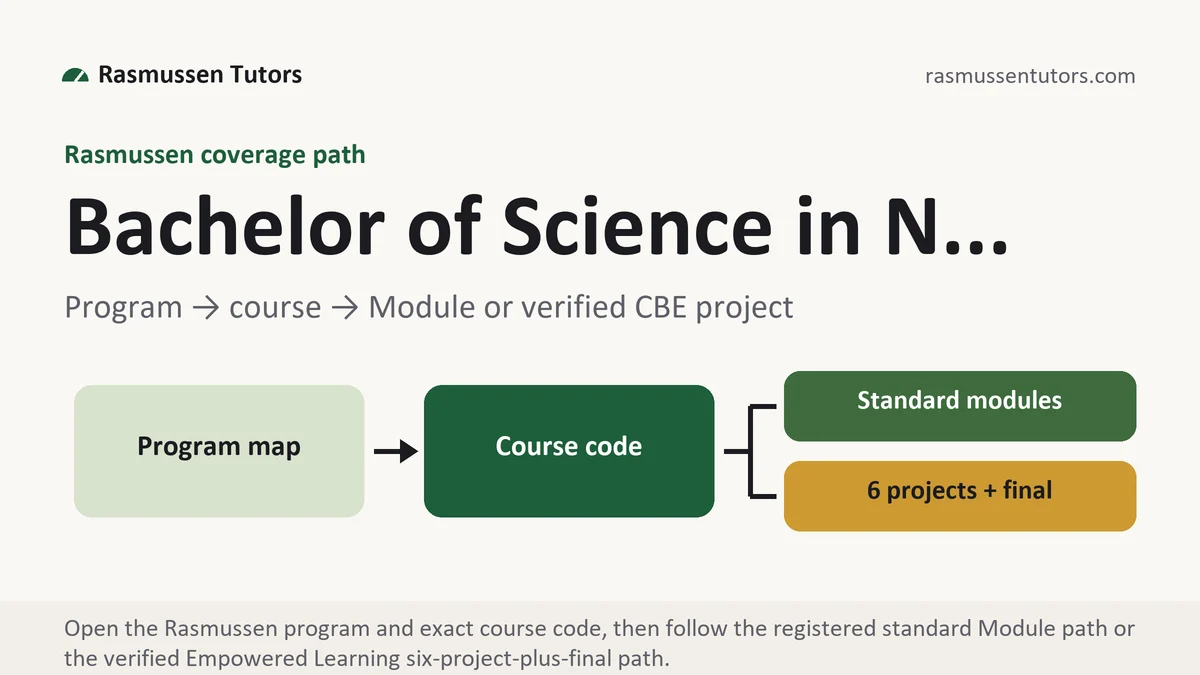
Program → course → Module or CBE project
This is an Empowered Learning competency-based path. Rasmussen's current model organizes a course into Modules aligned to competencies: six skill projects and a seventh final project. Projects are self-paced inside the term, the rubric is visible before submission, and feedback can lead to another attempt.
For a standard course, copy the live Module labels into a course board and attach each real assignment, discussion, exam, lab, or clinical obligation to the Module where it appears. The catalog proves the course, not a universal Module count. For Empowered Learning, keep the Learning Plan, six competency projects, final project, weekly discussion, rubric criteria, feedback, and resubmission state separate.
A linked manual appears only when the course-specific assessment identity is public and verifiable. MAN4845 is the current exception: Rasmussen publishes all six project names, competencies, deliverables, and the final project on its official Empowered Learning page. Other courses remain fully supported at class level without invented manuals.
Build the registered course board
Start with the active classroom, syllabus, calendar, grading scale, rubric, and current announcements. Record every obligation as its own row: exact label, Module, deadline and time zone, point value, rubric or exam rule, evidence need, dependency, current status, feedback state, and next action. If a program is campus-based, add lab, simulation, clinical, clearance, travel, and attendance obligations to the same board.
Do not turn catalog credit hours into a guessed weekly schedule. A four-credit course can use different Module designs across formats and revisions. The live course is authoritative for what is due; this network supplies the course map and a repeatable method for controlling the work.
Turn the rubric into acceptance tests
Copy each criterion into a requirement ledger before drafting. Give it an action verb, evidence requirement, destination, completion test, and status. Directions control scenario, audience, length, file type, and constraints; the rubric controls what earns credit. Both must be visible in the plan.
In Empowered Learning, a project demonstrates a named competency and can be revised after feedback. Treat each attempt as a new version: preserve the rubric, record the reason for change, revise the smallest complete unit, and trace that correction through dependent claims, tables, calculations, visuals, and references. In a standard course, reconcile awarded points with the gradebook after every Module.
Quality, nursing gates, and professional boundaries
Run a content pass before a delivery pass. Confirm that every criterion has an answer, claims fit their evidence, calculations expose inputs and units, recommendations follow from the analysis, and the narrative agrees with tables and visuals. Then check citations, template, filename, accessibility, and upload rendering.
Pre-licensure nursing students must also control the current exam-average and clinical rules printed in the active syllabus and catalog. Treat exam preparation and written work as two lanes; assignment points cannot rescue a required exam average that has not been met. Never round a forecast unless the governing rule says to round.
Students remain responsible for real discussions, decisions, data authorization, clinical care, laboratory procedures, practicum hours, signatures, identity-verified assessments, and final submission. Tutoring can explain, plan, review, calculate, rehearse, and help revise de-identified work; it cannot impersonate a student or manufacture experience.