Send any Empowered Learning project, course code and project number with the rubric, and our team returns a premium original draft in 24 to 48 hours, written so every single criterion clears the top band, because at Rasmussen a project that is excellent on five criteria and weak on one is graded as weak. The walkthrough maps each criterion to the passage that earns it, the free first sample proves the method, and if any criterion comes back low, revision is free until the score you need posts.
How an Empowered Learning course actually works
CBE courses, shown in italics in the catalog, replace weekly assignments with a project architecture: six projects, each aligned to specific employer-approved skills, plus a seventh final project that combines everything. There are no weekly deadlines; you work self-paced inside the term, keeping 14-day attendance windows alive, and projects need not be completed in order. Every rubric is visible before you start, and a deliverable that misses can be revised and resubmitted after feedback, within the attempt limits your course publishes. The philosophy is mastery: prove you can do the skill, at your speed.
That freedom is real, and so is its trap: with no weekly deadlines, the term's back half fills with everything the front half deferred. The students who thrive treat the seven projects as a dated plan from day one, which is exactly how our project bundles run.
The lowest-criterion rule, in plain numbers
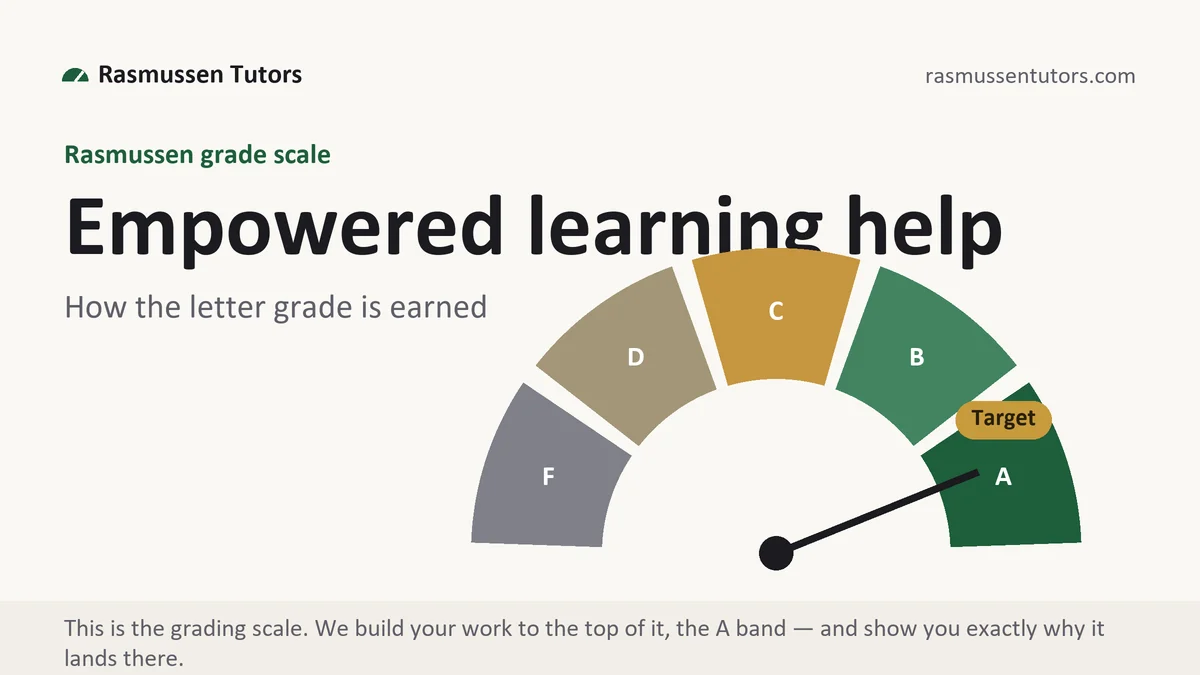
Rasmussen scores CBE work on a 4-3-2-1 competency scale that converts to letters: a 4 is 94 to 100 percent, an A; a 3 is 85 to 93, a B; a 2 is 78 to 84, a C; below that is failing territory. Two mechanics make it sharp. Every criterion must score at least a 2 for the deliverable to pass at all. And the deliverable's overall score equals the lowest criterion score on the rubric, not the average, so one thin rubric row drags an otherwise perfect project down to its level. The full conversion math lives in the grading manual; the practical consequence lives in how we draft, no criterion left to chance, because the rubric shows no mercy to almost.
What we deliver for any project
- A premium original draft of the full project, every criterion answered at the 4 band, in 24 to 48 hours
- The criterion map: each rubric row cross-referenced to the passage or artifact that earns it
- Skill-aligned framing, these projects grade workplace competencies, and the drafts read like work product, not homework
- APA or the course's required style, sources current and real
- A walkthrough that teaches the competency back, because the final project will recombine everything
- Free revision until the target score posts, attempt limits respected and planned around
Bundles cover a course's full arc, six projects plus the final, with one team holding the thread so the final's synthesis is genuinely a synthesis. And where a course can be skipped entirely, we say so: motivated students can test out of many CBE courses through the $149 Knowledge Credit self-directed assessments, and our honest first answer is sometimes "do not buy a project, buy the test-out," with prep support if you want it.
Pacing: the term is the price
Empowered Learning runs inside Rasmussen's subscription option, a flat price per six-month term, as many courses as you finish. That converts pace directly into money: every additional CBE course completed inside the term is tuition-free at the margin. The expedite page runs the full arithmetic; the short version is that project throughput is the whole game, and project throughput is precisely what a 24-to-48-hour drafting desk manufactures.
A project is sitting open right now
Send the code, the project number, and the rubric. First premium sample free, every criterion cleared.