HIM2966 Health Information Technician Associate Capstone help
A complete Rasmussen class guide: official identity, program backlinks, the correct Module or CBE method, rubric controls, and honest assessment boundaries.
This course provides the opportunity for students to demonstrate mastery of the Health Information Technician programmatic student learning outcomes and competencies obtained throughout the program. Through a case study project, students demonstrate their ability to integrate theory, practical experience, and transferable skills learned throughout the program in real life-based assessment activities. Students have the opportunity for review in preparation for the AHIMA® RHIT® exam.
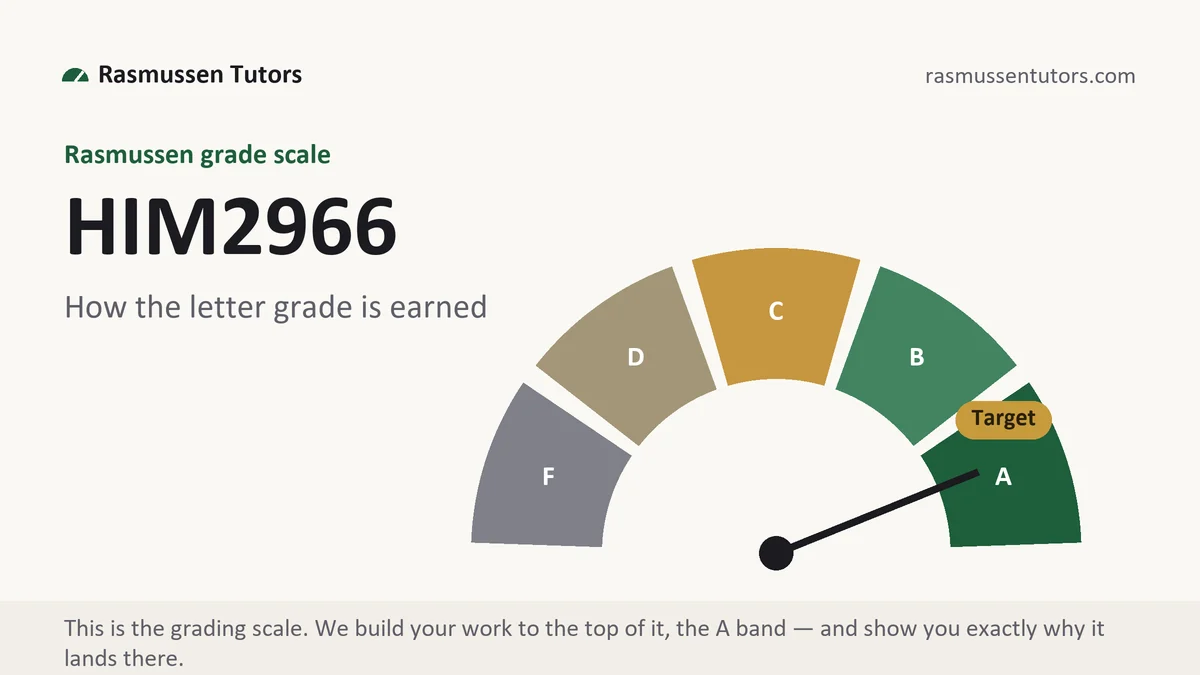
What HIM2966 is built to develop
This course provides the opportunity for students to demonstrate mastery of the Health Information Technician programmatic student learning outcomes and competencies obtained throughout the program. Through a case study project, students demonstrate their ability to integrate theory, practical experience, and transferable skills learned throughout the program in real life-based assessment activities. Students have the opportunity for review in preparation for the AHIMA® RHIT® exam.
The catalog description establishes the subject and public course identity. It does not expose the active section's Module count, due dates, discussion prompts, exam blueprint, lab directions, scenario, template, or rubric. Those details must come from the registered classroom.
This code appears in the following current program paths: Health Information Technician Associate's Degree. Open the program page to see whether the code is fixed, optional, a substitution, or part of a future-effective curriculum. The degree audit and advisor-approved schedule remain authoritative for enrollment.
The Modules, one by one
Standard Module path
The catalog verifies HIM2966 and Rasmussen uses Module as its native course unit. The public catalog does not publish a universal Module count or the current assignment names for this course. Copy each live Module label, deadline, discussion, exam, paper, lab, or clinical obligation from the registered classroom before planning.
No generic Module 1–11 pages are fabricated. A manual is wired only after the real current directions, rubric, or assessment instrument establishes an identity deeper than the course code.
Build the HIM2966 workboard
Copy the course start and end dates, time zone, grading scale, attendance rule, Module labels, and every scored or required event. Give each obligation its own row with exact title, points, deadline, rubric, source needs, prerequisite, feedback dependency, and next action. If work can be resubmitted, add attempt number, feedback date, revision target, and current status.
Keep instructions, rubric, and draft side by side. Directions determine the scenario, audience, length, file type, and constraints. The rubric determines what must be visible for credit. A requirement ledger prevents a polished document from omitting one small criterion or a correct calculation from being described with the wrong unit.
Draft from evidence and decisions
Start with the decision the deliverable must support. Build a source ledger with claim, source, date, authority, limitation, and intended use. Then outline by rubric row, not by the order in which ideas arrive. Put each table, calculation, recommendation, or example where the grader can connect it to the relevant criterion.
For staged projects, keep one continuity ledger across Modules: scenario facts, definitions, stakeholder names, data periods, assumptions, calculations, recommendations, citations, and instructor feedback. Update the ledger before the next project so the final does not join contradictory versions of earlier work.
Use feedback as the next Module's input
Classify feedback as coverage, reasoning, evidence, calculation, communication, format, or professional-boundary work. Repair the smallest complete unit, then trace the change through every dependent paragraph, exhibit, number, and citation. Freeze the submitted version and save the correction as a new version with the reason for change.
After grading, reconcile the rubric rows, written comments, and gradebook total. Record one prevention rule for the next Module or project. The goal is not only to repair one file; it is to make the next attempt begin with a stronger control.
Quality and integrity checks
Before upload, confirm that every criterion has a visible answer, claims match their sources, calculations expose inputs and units, limitations are stated, and recommendations follow from the analysis. Then check citations, references, template, filename, file type, accessibility, and exported rendering.
Students perform discussions, decisions, exams, labs, clinical activity, practicum hours, workplace observation, signatures, identity-verified tasks, and final submission. Tutoring can explain, plan, review, calculate, rehearse, and help revise de-identified work. It cannot impersonate a student, take an exam, or manufacture data or experience.
Questions about HIM2966
Is HIM2966 a current Rasmussen course code?
Does HIM2966 use standard Modules or Empowered Learning projects?
Where are the HIM2966 Module manuals?
What should I send for tutoring?
Working on HIM2966 now?
Send the current Module directions and rubric. Support starts from the real classroom artifact.